
Curved slabs · Marble and natural stone
We don't bend the stone.
We build the curve.
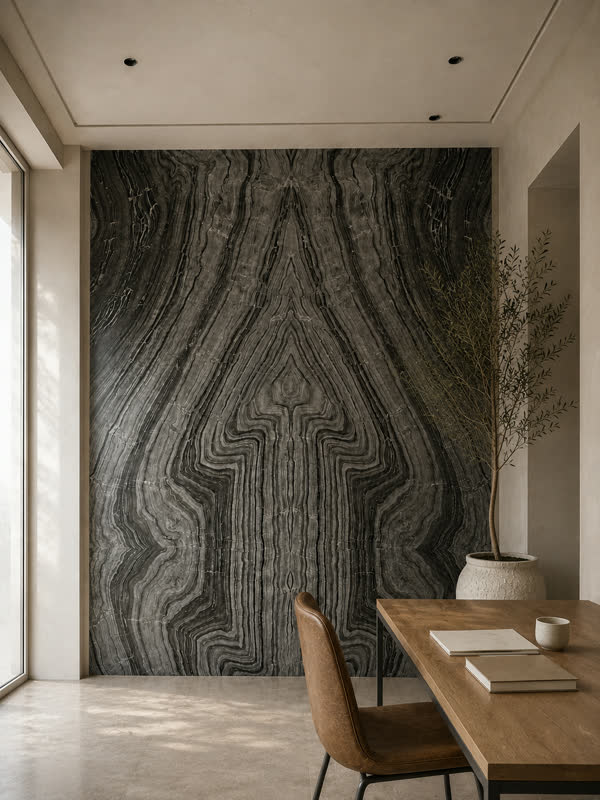
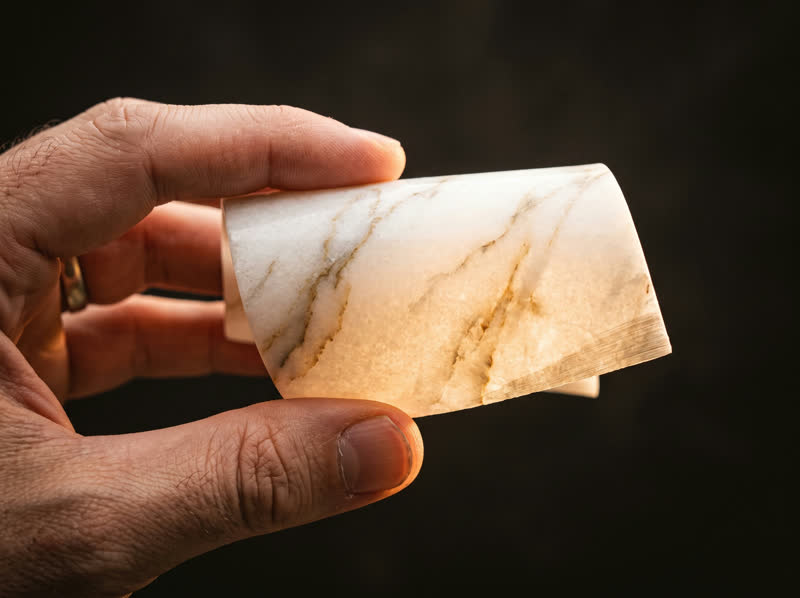
We build curved surfaces in marble and natural stone from the flat slab: this way the veining continues along the curve.
1 slab20 mmcontinuous veining
The method
From flat to curved.
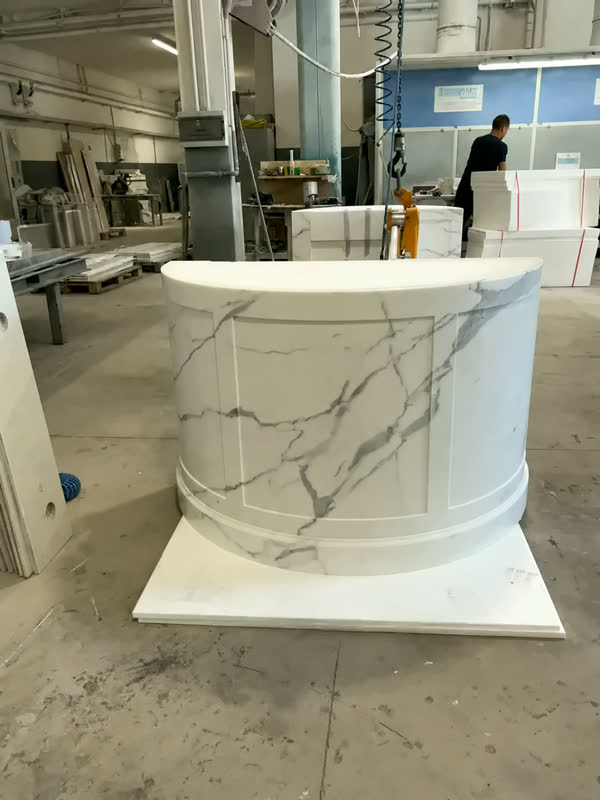
The slab is not bent: it is taken apart and rebuilt. The curve's geometry is divided into segments, each cut at a calculated angle, and the whole is assembled and finished until it becomes one single curved volume.
-
01
Selection of the real slab
The curve starts from the slab that will actually be used, chosen at the warehouse — not from a sample or an abstract model.
-
02
Reading the veining
The natural pattern is studied: direction, movements, strong points to preserve along the future curved surface.
-
03
Engineering the geometry
The project's curve is translated into a sequence of segments: how many, where, at which angles. This is where the quality of the result is decided.
-
04
Angled cutting of the segments
Each element is cut at the precise angle calculated for its point on the curve. We curve slabs as thick as 20 mm.
-
05
Assembly on the structure
The segments are mounted on a support structure designed and built by us: the curve and its skeleton are born together.
-
06
Surface finishing
The curve is finally CNC-ground, resined and honed.
Vein continuity
The vein continues, unbroken, along the curve.
Starting from the real slab means the pattern chosen at the warehouse is the same one that reaches the finished surface. When carving from a solid block, the veining changes with depth: what you see on the block's face is not what reappears as you dig.
From the slab, the reading stays the same: the veining continues from flat to curved, and on pairings across several slabs we apply the same criteria as in bookmatching.
Before production, the result is visible: the layout of the segments is designed on the real slab and checked with a dry lay in the factory. On site you install — you don't experiment.
The resin, point by point
One tone for the background.
Another for the vein.
The grouting is not a single colour run along the joint. The resin is mixed and varied for the exact point of the slab: background tone on the background, vein tone where the line crosses it, further variations where the pattern changes.
The comparison
Curved marble: block carving or curving from the slab?
Solid marble — the element carved from an entire block — is a technique we perform, and for certain projects it remains the right choice. Curving from the slab doesn't replace it: it is the alternative worth knowing when veining, weight, material or formats a block cannot offer are what matters.
The comparison below is the starting point: the real choice is made on the specific project, with the geometry and the material in front of you.
When to prefer the solid block
Bathtubs, washbasins and sculptures from the solid, elements with undercuts or full thicknesses on view, monolithic pieces where the mass is part of the design — like the Diamond Bathtub or the Travertine Bathtub.
When to prefer curving from the slab
Curved walls and cladding, counters and reception desks, columns, large formats, projects where the veining must stay readable or the weight is capped — on board a yacht as much as on an existing floor.
Applications
Where curved slabs are used.
Hospitality and retail
- Curved bar counters and reception desks
- Boutiques and luxury stores
- Hotels and restaurants
Home and furniture
- Kitchen islands and peninsulas with curved edges
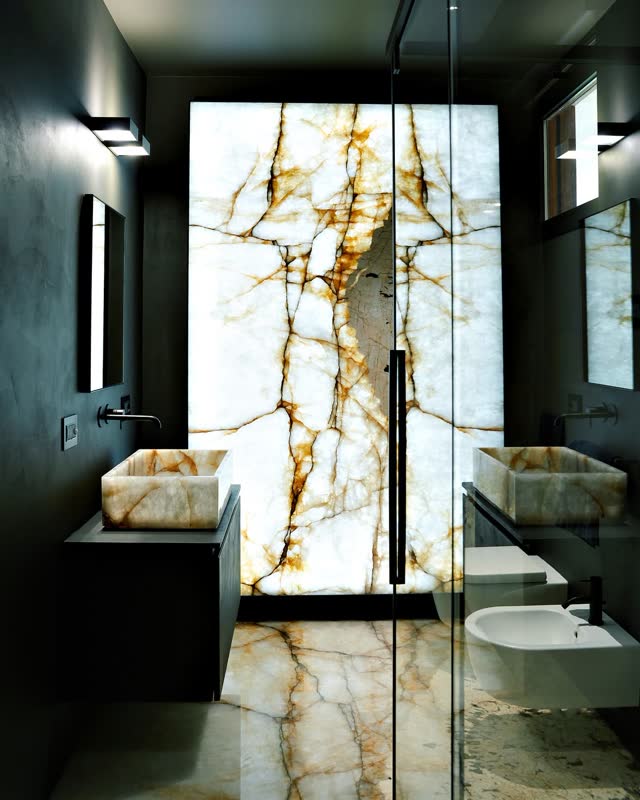
- Bathrooms with enveloping walls
- Tables, furniture and custom pieces
Architecture and marine
- Curved walls and cladding
- Clad columns and pillars
- Yacht interiors and sculptural elements
For outfitting where every kilo counts — marine first of all — curving combines with lightweight slabs.
From the workshop
Real work, not renders.
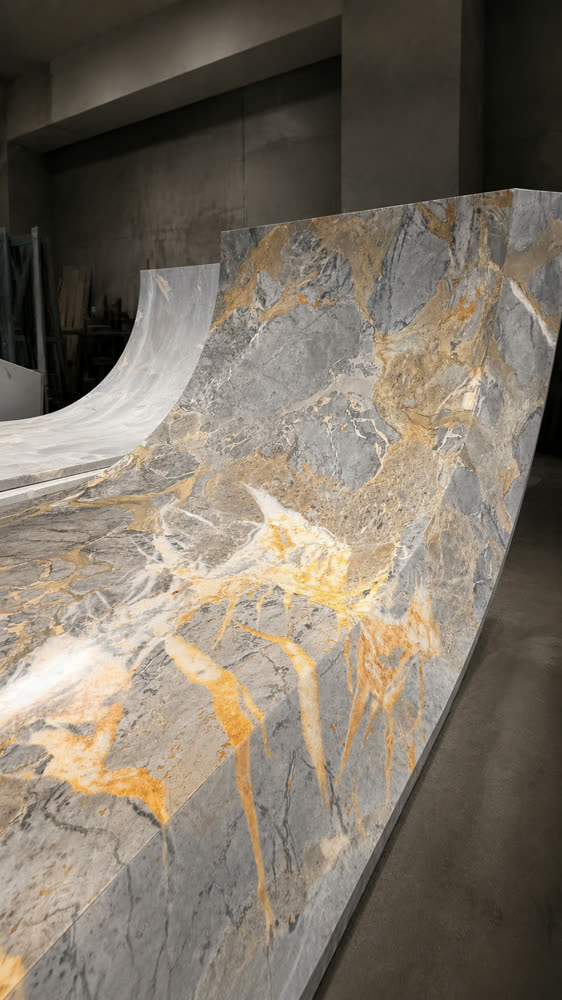
A freshly worked curved element on the bench: the segments are already a single volume and the surface is ready for finishing.
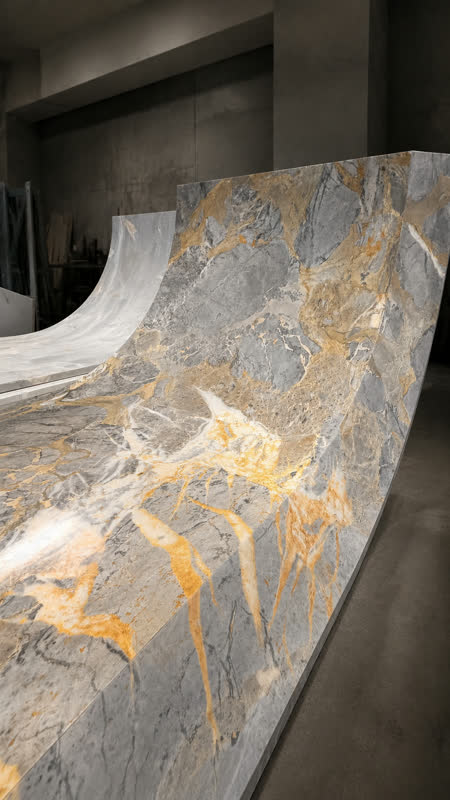
From floor to wall in a single pattern: the golden veining crosses the curve without breaking. It is the result this page describes.
More work — curved and not — is collected in our completed projects.
Frequently asked questions
Curving marble: the questions we get.
-
No. Natural stone doesn't bend and doesn't become flexible. The curved surface is built: the slab is divided into segments cut at calculated angles, assembled on a support structure and then worked down to the final curved volume.
-
All of them. The method never asks the stone to bend, so it applies to every material: marbles, travertines, onyx, quartzites and granites. The curve's geometry is then designed on the specific slab — compactness, veining and size guide the segmentation.
-
Yes, and it is the reason to start from the real slab: the natural pattern continues along the curved surface far more than when the piece is carved from a solid block, where the veining changes with depth. The layout of the segments is designed precisely to follow the stone's pattern.
-
No: they are imperceptible to the human eye, above all thanks to the technique we developed — the cutting line is gently curved to follow the stone's movement, and the resin is mixed point by point: background tone on the background, vein tone on the vein.
-
When the project calls for a monolithic piece carved from the solid: bathtubs, washbasins, sculptures, elements with undercuts and full thicknesses. It is a technique we perform — the Diamond Bathtub was born that way. Curving from the slab is the alternative when veining, weight, material or format matter most.
-
There is no single figure, and we won't declare a convenient one: radius and thickness depend on the material, the geometry and the element's use. We curve slabs as thick as 20 mm. The correct answer comes from the technical assessment of your project's drawing.
-
Yes. We start from technical drawings, 3D files or even a sketch: we engineer the geometry, design the segmentation on the chosen slab and share the construction solution before producing anything.
-
Yes. The structure the segments are assembled on is designed and built by us in Hekume, together with the stone element: the curve and its support come from the same design, not from separate suppliers.
-
We follow the project through to installation. Before delivery, every element is checked with a dry lay in the factory; transport and installation are planned together, around the site.
Have you designed a curve
in natural stone?
Send us a drawing, a 3D file or even just an idea: we assess material, geometry, veining and construction — before anything is produced, you already know what to expect.