
Backlighting · Marble, onyx and natural stone
Backlit onyx and marble:
light engineered on the slab.
We don't just put LEDs behind a slab: we study how your stone reacts to light and build a custom system around it — adjustable today, reachable tomorrow.
The translucency map
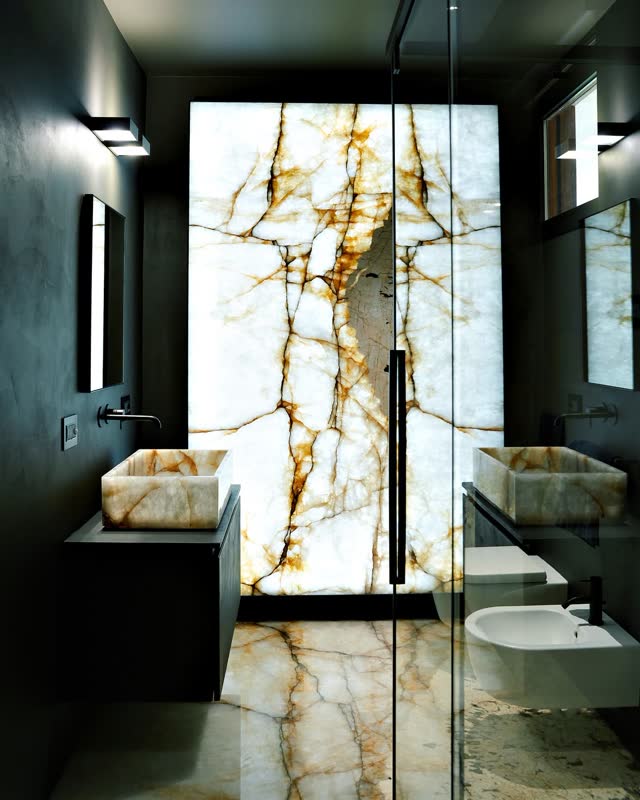
Every slab reacts to light differently.
Hold a slab against the light and you see it at once: zones that ignite, zones that stay mute, veins that draw shadows. Treat it as a uniform panel and you find out when the site is finished — halos, hotspots, surprises.
We light the slab first, then map it point by point. The map decides where the light must push and where it must pull back: there is no universal system, there is the system for that slab.
Translucency changes from block to block and even from slab to slab of the same material: the check is done lit, on the specific slab. At our warehouse in Verona the test can be done before you choose.
The method
From analysis to light.
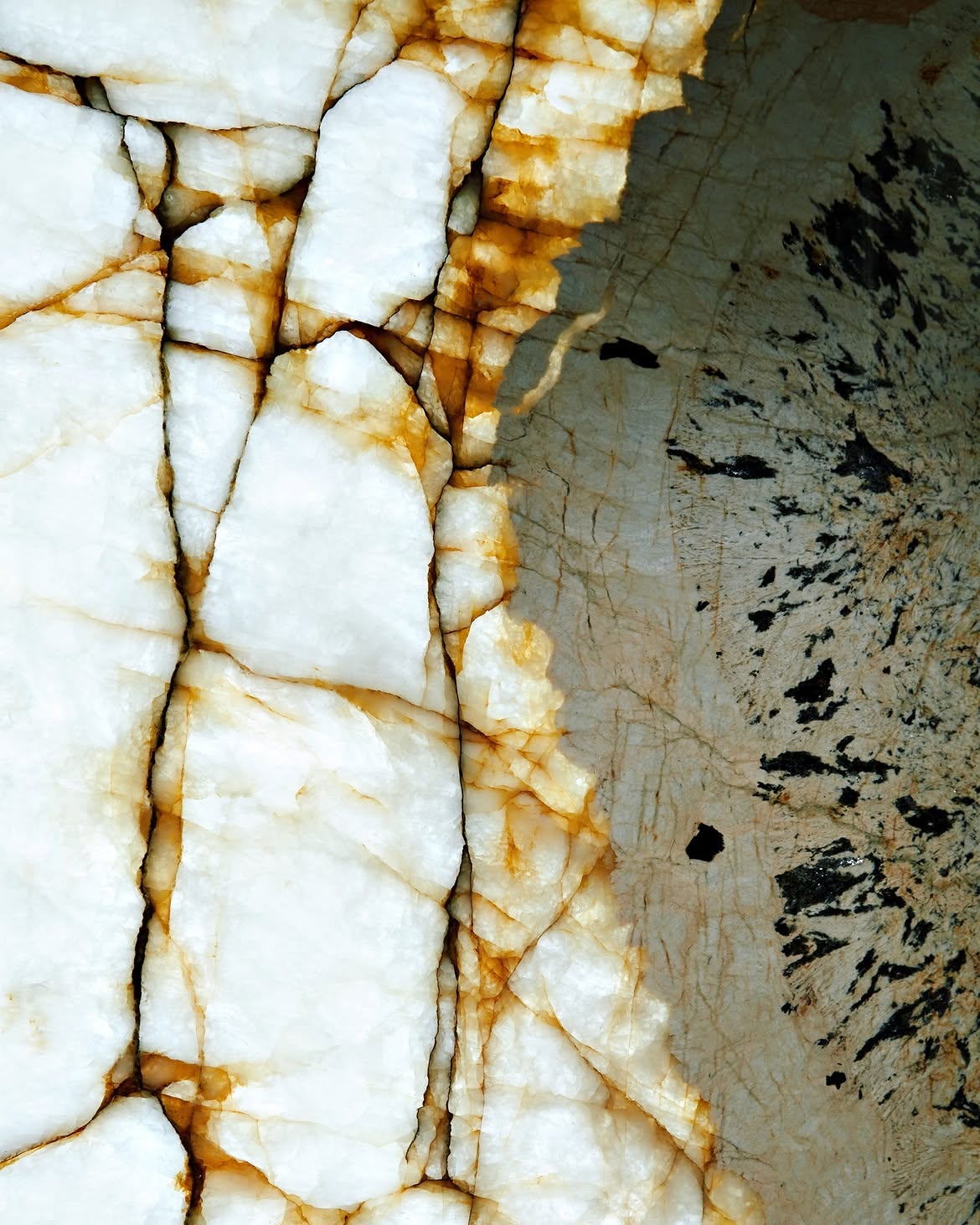
Backlighting does not start with the LEDs: it starts with the stone. The lighting system comes last, once the slab has already said how it wants to be crossed.
-
01
Selection of the real slab
The light is designed on the slab that will actually be installed, chosen at the warehouse — not on a sample or a data sheet.
-
02
Lighting test
The slab is lit up to understand how it reacts: where the light passes, where it fades, where it stops entirely.
-
03
Translucency mapping
Transparent, semi-transparent and opaque zones are traced one by one: this map will guide the whole system.
-
04
LED system design
Intensity, temperature, colour and distribution are defined on the map: more density where the stone absorbs, less where it lets light through.
-
05
Integration and access
The system enters the project structure together with its access point: maintenance is designed now, not after installation.
-
06
Calibration with the light on
Before delivery, the result is checked lit, in the factory — together with the dry lay. On site you install — you don't experiment.
Intensity, temperature, colour
The same slab, many possible lights.
Warm for backlit onyx with amber tones, cooler for white and grey stones — and if you don't want to choose, we install both in the same system: the wall changes register with one gesture. Dimmers, coloured LEDs and RGB stay available to the project. Never mandatory.
Demonstration diagram — real calibration happens on the actual slab, lit.
Beyond onyx and quartzite
Can a barely translucent marble be backlit?
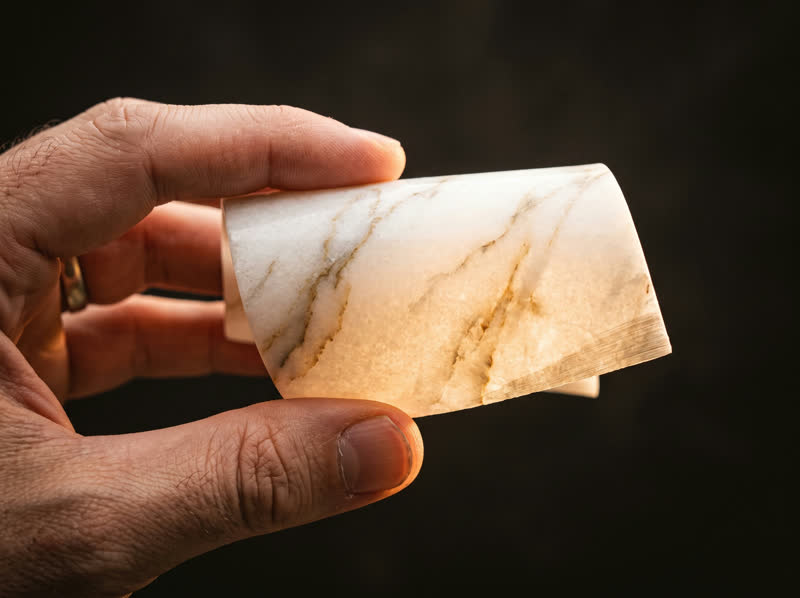
Onyx, quartzite, crystal, alabaster: they let light through on their own. Other stones stop at the thickness — a normal slab runs between 10 and 20 mm, and even composite panels don't go below 4.
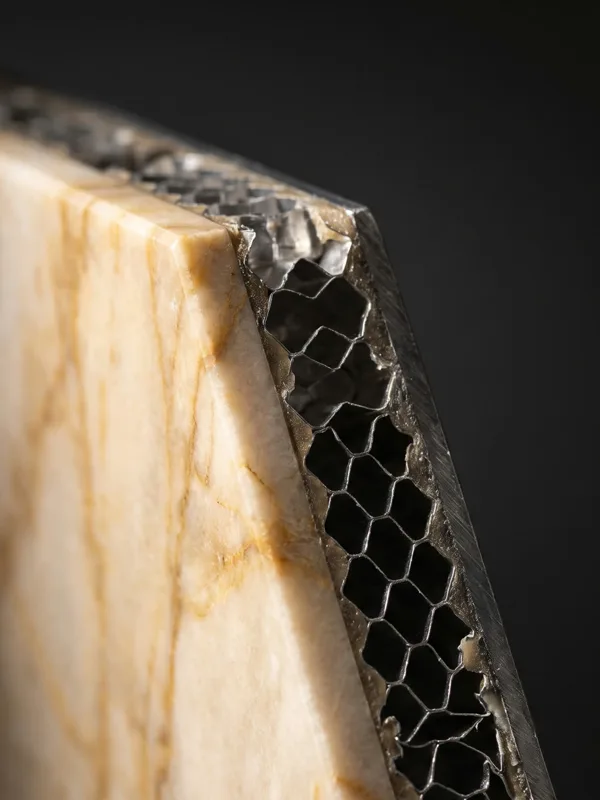
We go down to 3 mm, with a technique developed in-house. At that thickness even stones considered barely translucent start letting light through: you choose the material for the project, not for its translucency.
At 3 mm the slab is carried by a dedicated backing: it belongs to the same family of techniques as our lightweight slabs. Feasibility is checked on the slab and the specific project.
Serviceability over time
The light must stay reachable.
A system walled in behind a precious surface is a countdown. That is why we draw the access together with the wall: a panel opens, you reach the system, you close it again. The cladding is never touched.
This way the LEDs can be adjusted, extended or replaced even years later. Where to put the access depends on how the slab is installed: it is designed case by case, never after installation.
Access design
We work out how to reach the LEDs at the design stage, not after installation.
Integrated installation
The lighting system is built in without compromising the look of the slab.
Hidden service point
A dedicated access, invisible in plain sight, allows intervention whenever needed.
Adjustment over time
LEDs that can be adjusted, replaced or upgraded even years later.
We design the system's access too: if your project involves a closed wall or volume, let's talk before the structure is drawn.
Applications
Where stone becomes the light source.
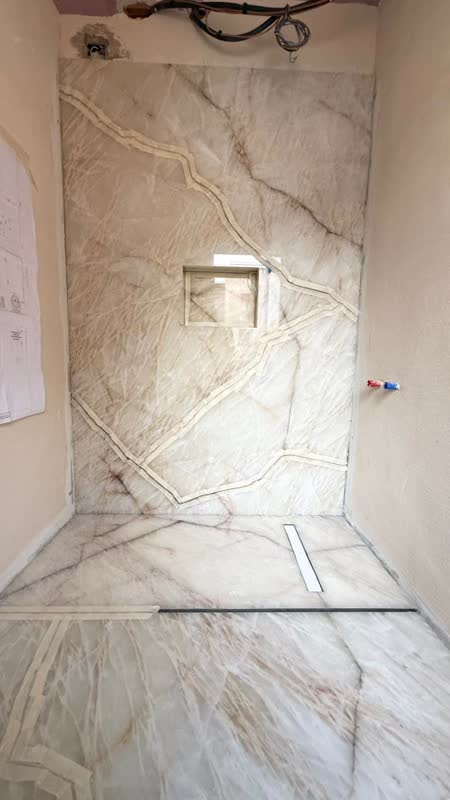
Backlit walls in marble and onyx
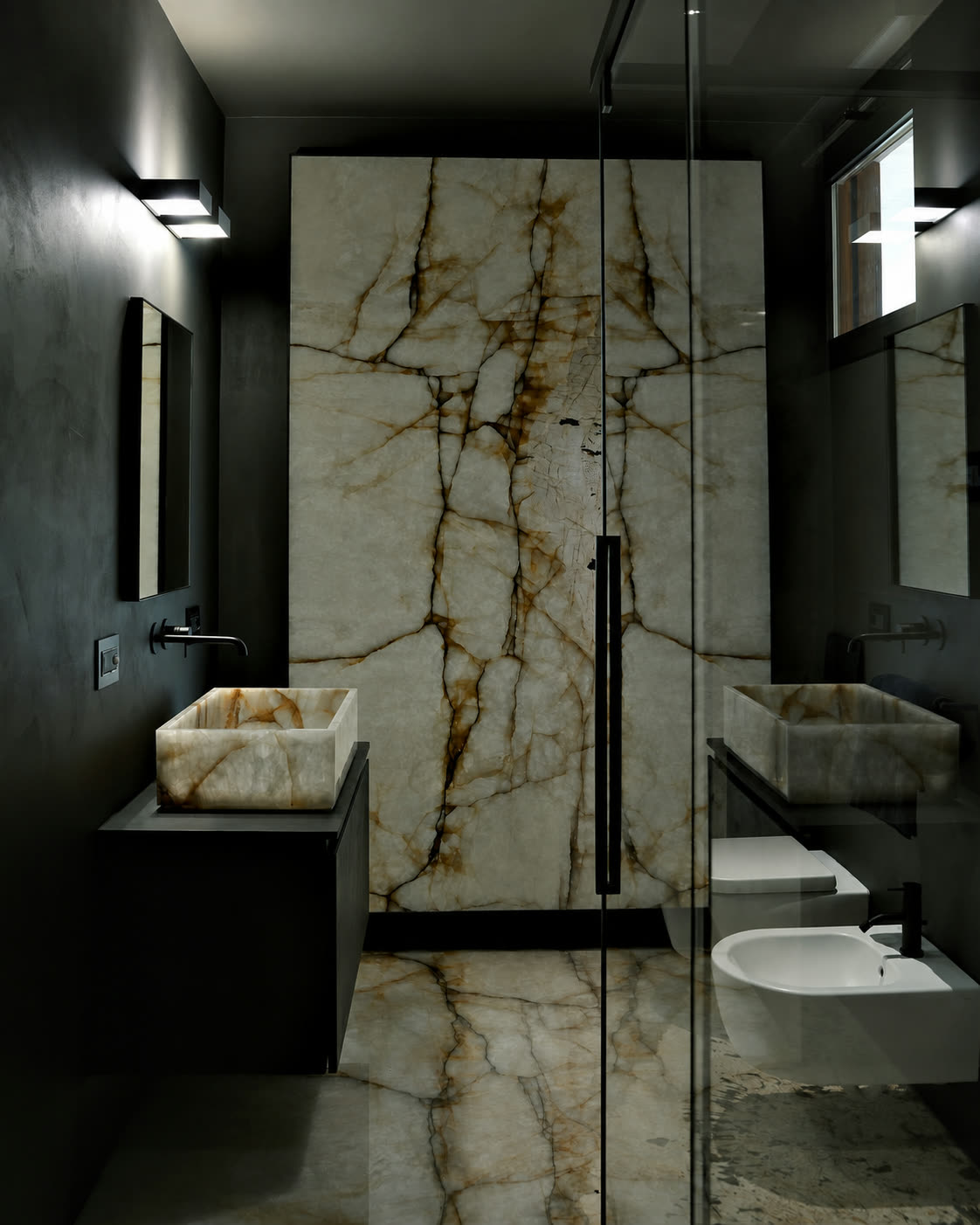
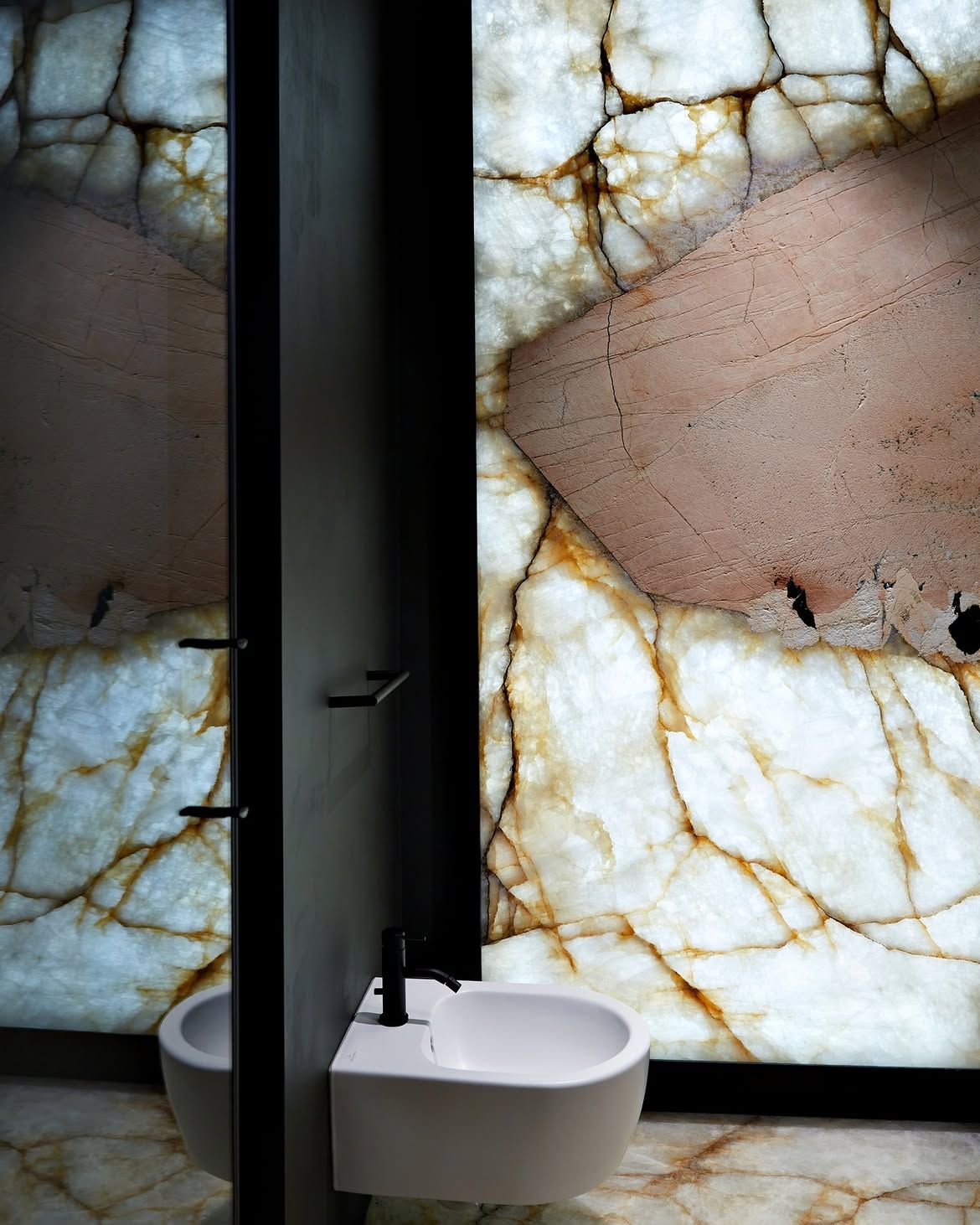
A backlit marble wall does more than furnish: it lights the room itself. Behind the bed in place of a headboard, in a bathroom, in a hotel lobby or a spa — the lit stone replaces lamps and scenic backdrops, with intensity that eases down in the evening and a system that stays reachable.
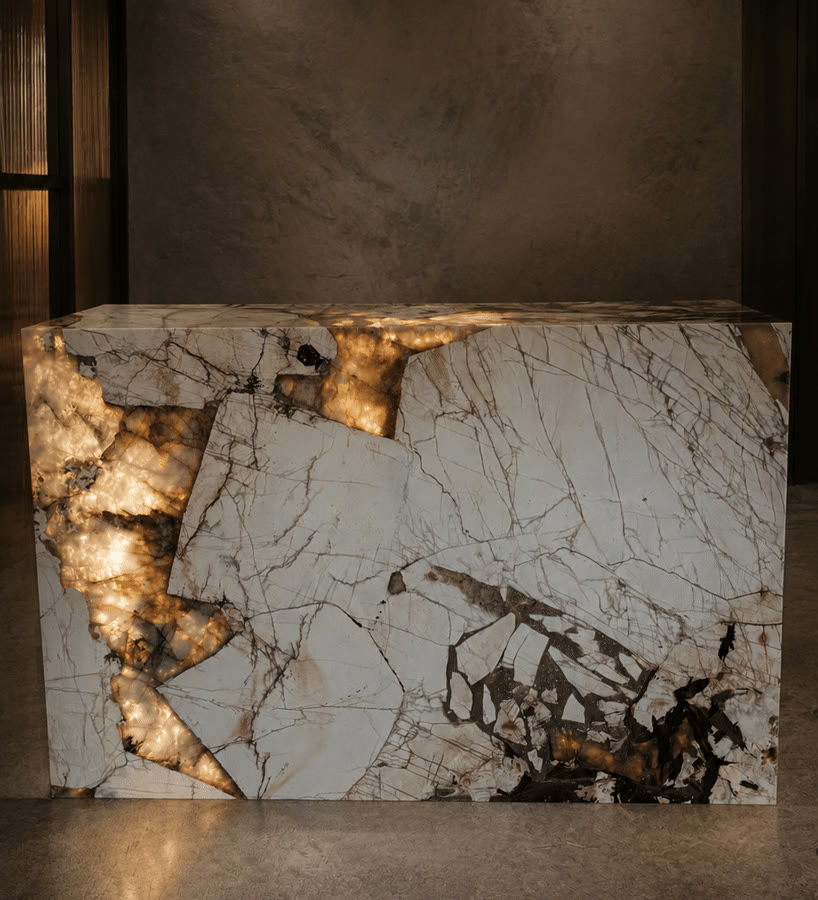
A counter can become the light of the space.
In a dim room, the lit counter is the first thing the eye finds. Bars, hotel receptions, boutique desks: no visible spotlights — the stone volume itself makes the light. In this desk the quartzite ignites only in its crystalline zones: exactly what gets mapped and designed, slab by slab.
Home
- Kitchen islands and backsplashes
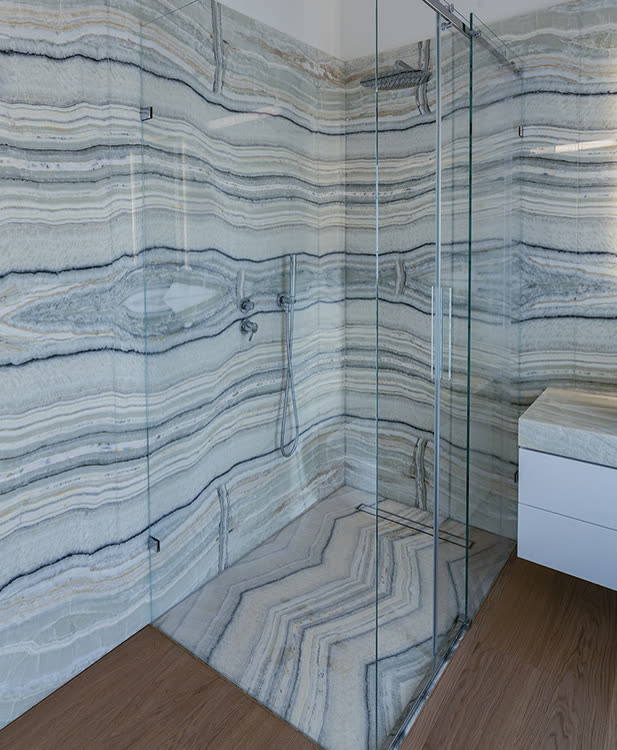
- Bathrooms, showers, washbasins and tubs
- Headboards and niches
- Tables, doors and custom furniture
Hospitality and retail
- Hotel lobbies and receptions
- Cocktail bars and restaurants
- Spas and wellness centres
- Boutiques and showrooms
Special projects
- Stairs and floors with integrated light
- Stone ceilings and suspended ceilings
- Yacht interiors — with lightweight slabs
- Installations and wine cellars
Real projects
The light, inside real projects.
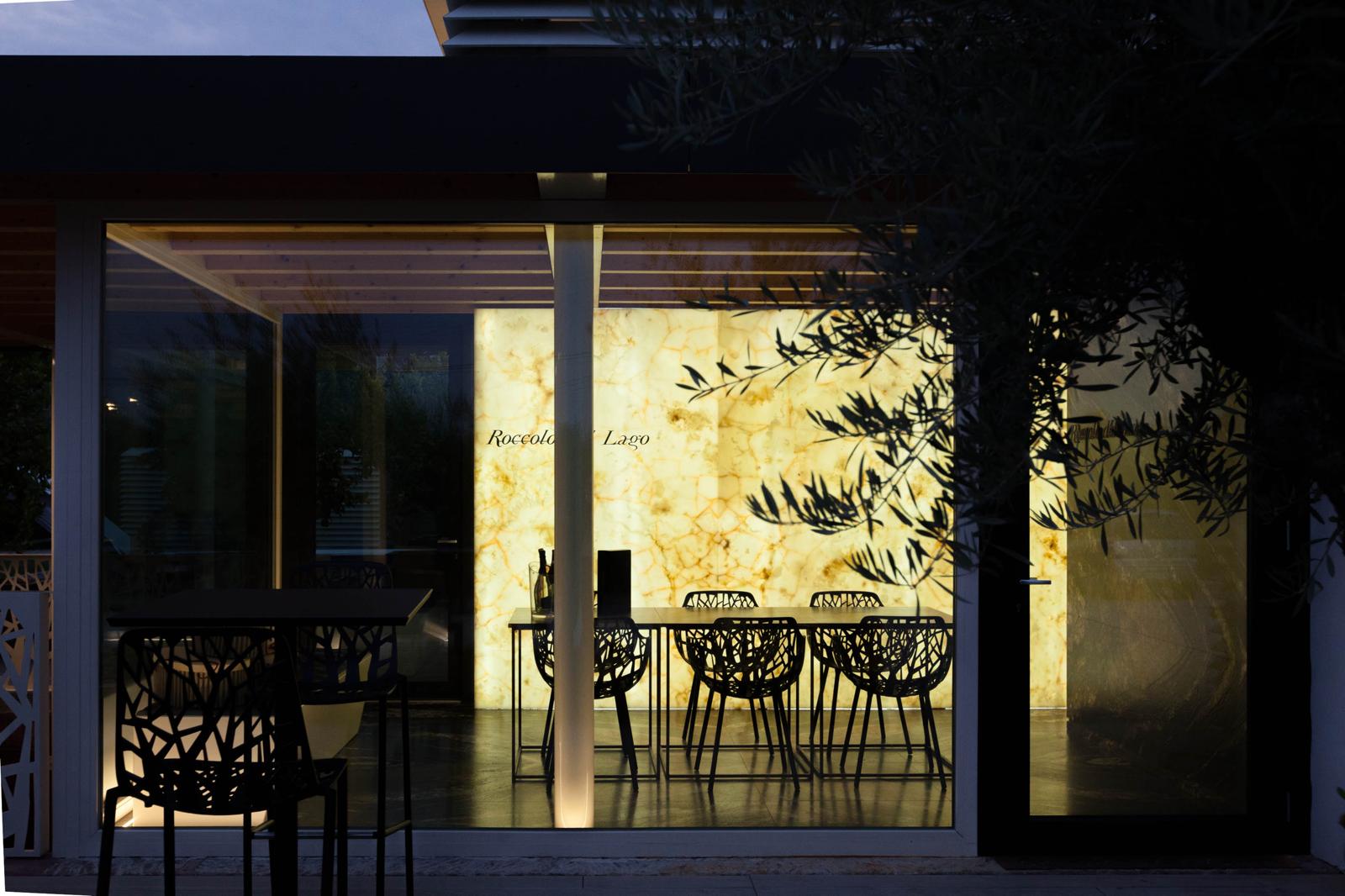
At dusk the tasting room doesn't switch on chandeliers: it switches on the wall. The slab was tested and calibrated lit before installation, and the system remained reachable for adjustment and maintenance.
Frequently asked questions
Backlighting marble: the questions we get.
-
Naturally translucent are onyx, alabaster, alabastrine travertine, certain quartzites and the lightest white marbles. Thinning to 3 mm moves the boundary: we can consider backlighting even stones normally regarded as barely translucent — Patagonia included. The check is done on the specific slab, because translucency changes from block to block.
-
Because it is translucent by nature: light passes through it without any thinning, and in passing it ignites the veining instead of flattening it. A backlit onyx doesn't look like a surface lit from behind: it looks like a stone emitting its own light.
Warm tones bring out its amber and honey hues; on lighter and green varieties a neutral light works better. It remains a delicate stone, though, so where it gets touched every day — a worktop, a washbasin — it should be weighed against the intended use.
It is not the only road: alabaster, alabastrine travertine, certain quartzites and the lightest white marbles let light through, and at 3 mm the boundary moves further still.
-
A slab is normally calibrated between 10 and 20 mm, and composite panels reach about 4. We go down to 3 mm: less thickness means more light passing and the chance to use less translucent stones. Thickness is not chosen on its own though — it depends on the material, the size and how the slab is supported.
-
It is not a problem we unload on the client: we take care of it, designing the system around the chosen material. Instead of a few spaced-out sources we use thousands of LEDs on a single slab, so the light comes out even and hotspots never form. The result is still checked lit before installation, not on site.
-
It depends on the material: warm tones enhance amber onyx, honeys and golden veining; cooler ones work better on white and grey stones. But you may not have to choose: we can install both lights in the same system, switching from one to the other with the time of day. Dimmable LEDs adjust the intensity; coloured and RGB LEDs remain an extra possibility, when the project calls for it.
-
Yes, if the access was designed in — and that is exactly what we do. For every job we design a hidden service point that lets you reach, adjust or replace the LEDs even years later, without dismantling the cladding. There is no universal solution: it depends on where the slab is installed.
-
Yes: the headboard or the wall behind the bed is one of the most requested applications. We study the slab, the support system, evening dimming and the access point to the LED system, so the wall stays serviceable without dismantling anything.
-
Yes: bar counters, reception desks and boutique desks are among the applications where backlighting pays off most, because the volume itself becomes the light source of the space. The system is designed together with the counter structure, access included.
-
Yes, and it is the path we prefer: translucency is judged on the real slab, lit — not on a sample or a data sheet. At our warehouse in Verona the test can be done before the material is confirmed.
-
Yes. We start from technical drawings, 3D files or even a sketch: we study slab, LED system, structure and access, and share the solution before producing anything.
-
We follow the project through to installation. Before delivery every element is checked lit and dry-laid in the factory; transport and installation are planned together, around the site.
-
Feature walls, headboards, bar counters and reception desks, kitchen islands and backsplashes, bathrooms and showers, niches, stairs, wine cellars, spas, boutiques and yachts. Anywhere a surface should become the light source itself, instead of being lit from outside.
You've chosen the stone.
Now let's design its light.
Send us a photo of the slab, a drawing or the project: we'll study translucency, dark zones, the desired effect and the LED system's serviceability — and if needed, the test is done lit, at the warehouse.